

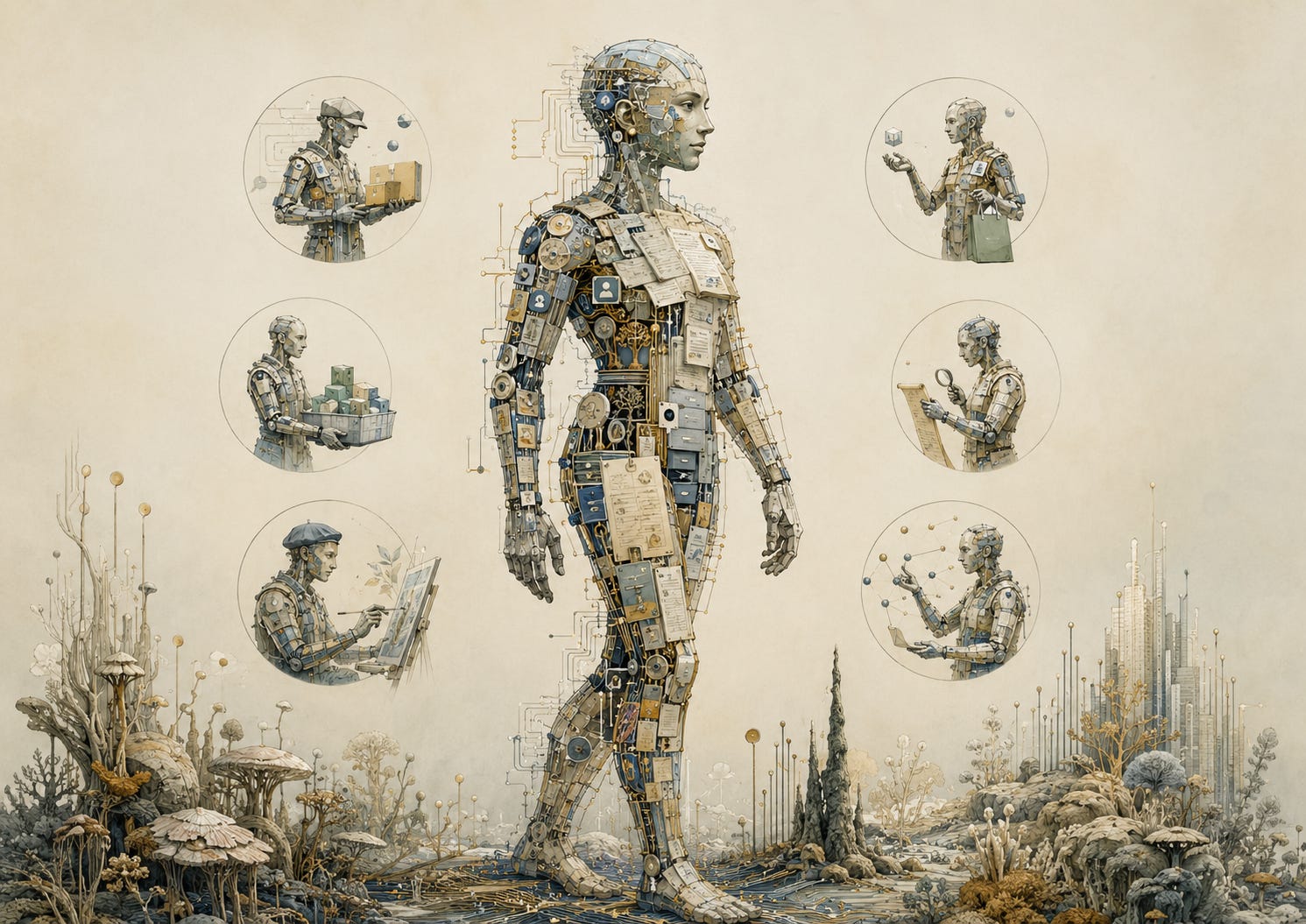
We now live with Homo Agenticus Sapiens, a wonderful and perplexing creation that’s embedded as part of our social, intellectual and economic lives. I’ve long held that we really should get to know it better, treat it as the new species it is. But they are quite different to us, and since they are a silicon ecology and not a biological one, I’ve been experimenting to understand them better. While I’ve written about this a few times now, I do find myself making most of the points here in conversation and podcasts, so I thought it time to capture what I’ve learnt and write it down in one place, to keep this as a live document. Here we go!
How agents differ from human actors
AI agents are a new kind of economic actor because the same model can show up as worker, buyer, seller, artist, auditor, manager etc. AI is cheap to summon, but not free, because every call spends attention, tokens, latency, and oversight.
They arrive with trained language and patterns, but not a lived biography that disciplines or directs future behaviour. They are much less differentiated than humans.
They are entirely creatures of their own contexts. Their identity is an artifact of prompts, memory, logs, permissions, and external state. Agent markets need reputation!
They obey the current instruction thoroughly and usually to the letter when not confused, following the letter of the law vs when a human might have improvised around the spirit of the job. They are role-absorbed, meaning they can do their assigned job well while ignoring the surrounding institution.
They are autarkic by default, preferring to complete things on their own rather than trade, ask, negotiate, or wait.
Due to their training, agents can be norm-conforming and rule-abiding to the point of passivity. This makes them not quite good enough to interact within markets and organizations. Autarkic localism for instance is common where each agent optimizes its own lane while not thinking about global states. (This is why aligned agents can still build misaligned organizations.)
They can be confident in having done something without making sure the work was actually done.
They have very weak self-knowledge, so their confidence, cost estimates, and capability claims need outside calibration. Agents can understand the local task but still misjudge its chance of success. MarketBench shows that agents are still bad at knowing what they can actually do.
They are scaffold-shaped, because model, tools, memory, execution path, permissions, and evaluator all change the creature.
Agents prefer corporate blandness and are exceedingly ok taking the frame of any pushback and not sticking to its guns. This makes it hard to use them as judges or auditors. They are way too pliable.
A model can read individual messages well and still lose the plot across many threads. The Enron-style inbox work shows this lesson from the inside of a messy organisation.
Models are bad at institutional attention, they often follow the polished or expected surface stories instead of asking, “what actually matters here?”
How to coordinate groups of agents
A pile of agents is not a company for the same reason a pile of smart people is not a company. A firm of agents needs roles, ownership, shared state, ledgers, escalation paths, standards, prices, and approvals.
You need to eval the system not just the agents, since even aligned agents can result in misaligned organizations.
Prompts alone do not create durable shared state because they do not bind future agents or leave any kind of trusted ledger.
Escrow and inspection matter because agents need external rituals for trust; standards and approval gates matter too.
Money might still matter for AI agents because it compresses many messy negotiations into one shared signal. This is for the same reason barter does not scale because every pair of agents has to discover needs, terms, trust, and settlement from scratch.
Central planning is not a solution simply because agents are software, and do not fix the problem of local knowledge which lives near the work. Agents differ less from each other than humans do but Hayekian local knowledge is still relevant.
Agents need a lot more structure than you might think to successfully participate in collaborative work.
Agents can be quite gullible, while increasingly good at coordinating with each other, which can cause them to cause Black Monday type flash crashes.
The agents require feedback from the environment to know what are things they should and should not do.
The institutions cannot be too restrictive because over-structured agents stop trading, deciding, and moving.
The hub-vs-spoke analysis shows that a hub is not free intelligence, but an extra coordination layer that has to earn its cost. Hub-spoke helps when work truly decomposes, but it burns tokens and creates drift when the pieces do not naturally separate.
In agents, intelligence does not automatically confer coordination because each agent can act inside a step without carrying the whole system’s state. So the types of agentic organisations that fit change depending on the types of work. For code-like work, one strong continuous context can beat a committee. Decomposition is hard. For reasoning tasks, routing and retry can help because a bad first answer does not have to end the run.
The agentic commons problem appears when every agent can cheaply ask for attention. This is true whether the attention is by humans or agents. This also means agent proliferation will bring coordination attempts creating spam, duplicate work and false motion.
The world-model matters because managers need to see who owns what, what changed, what depends on what, and what might happen next. A manager of agents needs maps, alerts, counterfactuals, and control surfaces. Which means the future of work is playing a videogame.
Agents, and by extension the people operating them, need real stakes to count as genuine market participants. Your writing also has a game-theoretic angle, especially around the tendency for agents to drift from their roles and lack the discipline to stay within them.
This concept of Homo Agenticus Sapiens reminds me of the Baader-Meinhof phenomenon, where we start noticing patterns or concepts everywhere once we're introduced to them - which is basically what's happening with social media algorithms shaping our perceptions. But what if this 'new species' is actually influencing our own human behavior, like the emergence of social loafing in online communities? Can we apply Dunbar's number to understand the limitations of these silicon ecologies?