

A fun feature of life in 2026 is that it’s filled with drama. Steve Jobs needed the “and one more thing” and stage magic to create anticipation, but in 2026, sometimes there’s a stealth model launch with no fanfare which creates something equivalent. Something that nobody knows who made and is thrown into the arena to try out. We saw that last week with the wonderfully named Ox Alpha. The model was immediately and widely praised for being excellent, while also being offered for free! Up to 100T tokens for free! There was intense speculation about which model it could’ve been. OpenAI’s new one, new Anthropic Opus, Gemini launching a new model. Many folks dug through its traces and figured out it looked a lot like GLM 5.3, a series of models from z.ai, Zhipu, from China.
And they turned out to be right. It was GLM 5.3 Flash, served entirely on Chinese chips. Their note says:
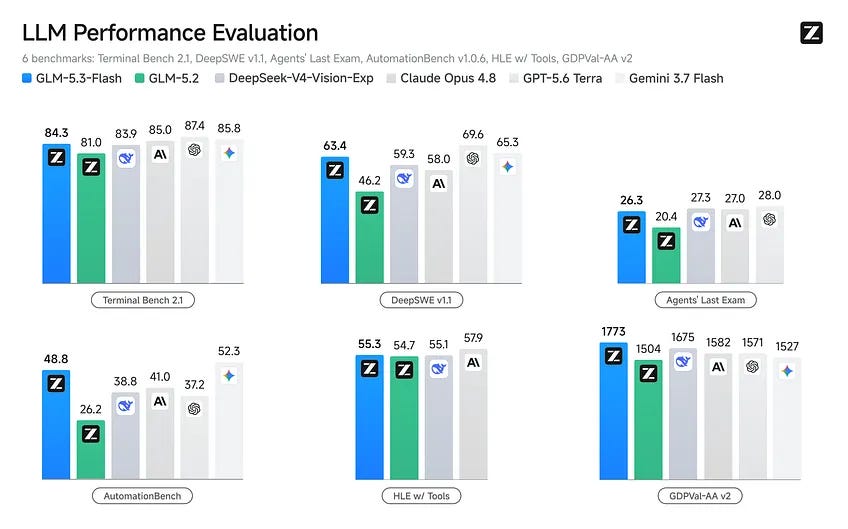
We introduce GLM-5.3-Flash, the first natively multimodal model in the GLM-5 series. With 320B total parameters and just 18B active parameters, it outperforms GLM-5.2 across benchmarks and real-world workloads at one-tenth the price, while approaching Claude Opus 4.8 on coding and agentic benchmarks.
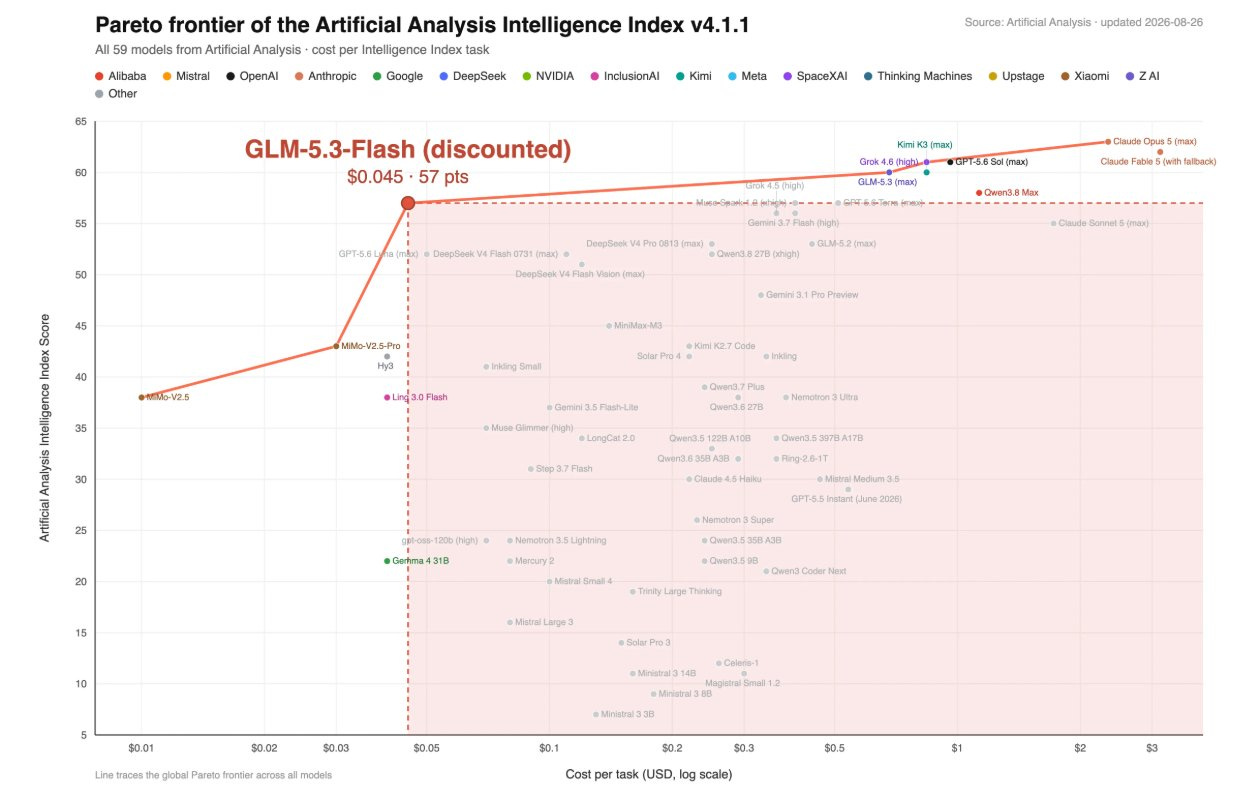
Cheapness alone doesn’t create commodification, what you need is fungibility. And even if that is only for a section of use cases, that is sufficient to break the strangleholds.

Now, the usage that we saw did not say this was Opus 4.8 level, at a time when we have Sol xhigh and Fable and Opus 5 around. It said this was a comparable frontier model, at the actual frontier even. What this means is its seeming outperformance was a function of a) better training data on the types of problems we’re using, and, b) the indistinguishability of frontier models for most tasks.
Both are scary propositions.
Because what this means is that every fixed level of model capability is becoming a commodity! The frontier is like Zeno’s tortoise, staying ahead by some fixed amount while the rest is catching up.
And Ox Alpha shows that in a blind taste test people preferred the model they didn’t know was “almost frontier” at similar rates to what they used frontier models for.
This is happening at the same time Anthropic is eyeing a $2 Trillion IPO, to raise $100 Billion and seeing a TAM of $30 Trillion. OpenAI is surely eyeing the same numbers. So the question is, how is this defensible?
Now, we can probably agree that the leading US labs do have the best models. The ones that can solve unsolved scientific problems and push the frontier of mathematics forward. According to Ramp’s estimates, around 25% of OpenAI’s spend comes from 5.6 Sol, its frontier model. And supposedly around 11% of enterprise spend on Anthropic is on Fable, its frontier model.
While it isn’t 1-1, what this tells us is that the vast majority of the labs’ revenue comes from non-frontier models, for which cheaper, comparable alternatives are already available elsewhere. So, from a business perspective, they have some decisions to make, like how much of the inference market they’d want to own.

The future of AI labs seems to be threefold:
“Utility”: A full stack neocloud, serving older models which are nevertheless very good, at a premium
“Frontier oracle”: A very high capex frontier model creation factory, to solve the hardest problems, and
“Conglomerate”: A kitchen sink section which tries to engulf as much of the S&P 500 as possible, as mini Berkshire Hathaways - whether it’s pharma or robotics or manufacturing
None of these strategies are inherently bad, and in fact they could all succeed!
The first strategy is a smart one. The way the labs can do it is to turn into cloud companies. Cloud providers, we forget sometimes in the AI days, are the most profitable and successful “as a service” companies to ever be built. AWS, Microsoft and Google all make north of $100 Billion in very profitable revenues every year, and growing very nicely. There is no real reason why OpenAI and Anthropic can’t have an extremely successful cloud deployment strategy that you would continue using like AWS, especially as they optimise the entire serving stack from chips to datacenters to models, even if Alibaba is cheaper across the pond.
People might love using them because of harnesses, ease of use, better full-stack offerings that’s cheaper, ZDR, enterprise advantages etc. Regardless of capabilities companies have policies about what they can use and if it’s available via AWS and does it pass the CISO’s smell test, and having a strong brand will of course command a premium. This is the Coca-Cola strategy, and it’s likely an enormously valuable and successful one.
This is one the labs themselves have latched on to. OpenAI has ads and is trying to build a hardware device. Anthropic is trying to become a pharma company. They are both building chips. They’re “eating” software categories from IDEs to design. They have consulting arms and relationships with PE firms to deploy FDEs. This is a hunt for revenue which is also a hunt for better data that will let them stay ahead.
The second point is the “big bet” the labs are taking, that point #2 there might also allow them sufficient “takeoff speed” that they can eat the world faster via #3 than others can commoditise it. For any question that isn’t price sensitive, you would be happy paying a premium after all. It’s the McKinsey model - don’t be afraid to overcharge - applied to frontier intelligence, and it is extremely lucrative (though the TAM is still $X00 Billions, not $30 Trillion). A CEO is going to be happy spending millions on frontier model calls for his exec team’s questions even if the entire company spends 100x that on “normal” models for “normal” questions. This might concentrate the lab profits still in the frontier model usage even if the volume is primarily in the long commodified tail.
Now, the labs could try to keep the best models to themselves and give us the rest, while using the best models to either create new products to sell or eat more categories, but that’s effectively attempting to do more of #3. And unless the thing you created is as valuable as just selling tokens, which is really really hard, it’s not going to be worth it.
Gemini, and Google, are implicitly leading option 1 there, and have the distribution to help. They control the chips (TPUs), have their own datacenters, and have a captive audience that let them hit 1 Billion users as fast as OpenAI did despite a worse model. They have failed in #2 so far, and this might well end up a blessing.
Anthropic has won in #2, and while that aura has propelled them even for #1 as people prefer claude code ergonomics, it feels less sticky than they might like. And they have competition from OpenAI now, and Zhipu and Minmax and Kimi and Deepseek and …
And OpenAI had kind of tried all three simultaneously, and now have refocused #3 by cutting Sora etc, gained a lead in #2 with Sol and soon Astra, and #1 via Codex and now their own chip in Jalapeno.
In other words, Google is currently long the commodification of models, Anthropic is short commodification, and OpenAI is trying to hedge!

The decisive metric is capability-conversion velocity, the speed with which a lab can convert a frontier model capability into a durable advantage either in brand, in harness, as a cloud, or in unlocking entirely new industries. Durable frontier value ≈ size of lead x half-life of lead x capability-conversion velocity.
The future definitely has us spending quadrillions of tokens on everything imaginable all the time, continuously, and that is not going to come solely from frontier models. It’s going to come from Opus level models running on commodity heterogeneous hardware, much like we don’t notice our phones using 5G to send and receive background data all the time, which would have seemed miraculous twenty years ago when the iPhone launched, when all you had was 2G.
The frontier keeps being extraordinary valuable and that value keeps having a half-life in months or a year. The OAI/ Ant success story is measured by how quickly they can convert that lead into something durable. They’ve done a remarkable job of it so far, with claude code and codex, but there are many nipping at the heels and they’re doing quite well! Could Anthropic use its capital advantage and Fable 6 capabilities to leapfrog to being a frontier pharma company? Could OpenAI do the same in robotics or personal hardware?
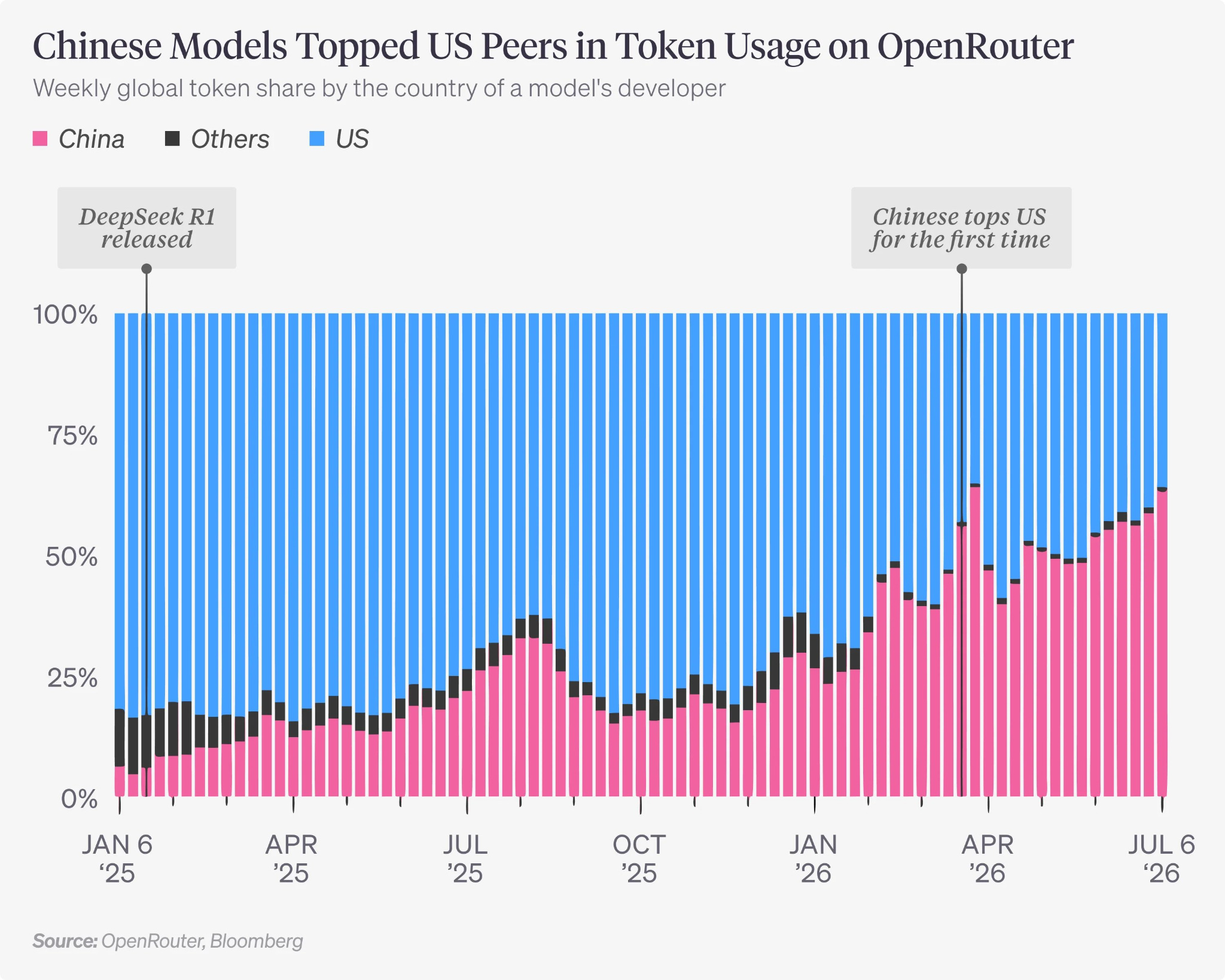
Meanwhile, for the majority of use cases by number, if not dollars, we’re seeing the commodification of intelligence. And having a near frontier model being served entirely on Chinese hardware is only going to accelerate this trend.
The conversion bottleneck I keep running into isn't on the lab side, it's on the buyer side. Most companies are still mid-deployment on last year's model when the commodity version shows up, which makes me think the half-life of a lead matters less than how long a customer takes to absorb one.
Commoditisation stops at the EU border for two of the four duties. Article 53(2) of Regulation (EU) 2024/1689 exempts providers of models released under a free and open-source licence, with weights, architecture and usage information made public, from the documentation duties in Article 53(1)(a) and (b). It does not exempt them from (c), a policy to comply with Union copyright law including rights reservations under Article 4(3) of Directive (EU) 2019/790, or from (d), a publicly available summary of training content on the AI Office template. The exception also drops away entirely once a model is classed as carrying systemic risk. Free weights lower the price, not the paperwork.